

Which Of The Following Is The Maximum Disk Size Supported When Using Gpt Partitioning?
| Developer(south) | Microsoft |
|---|---|
| Full name | NT File Organization[2] |
| Introduced | July 1993 (1993-07) with Windows NT 3.1 |
| Sectionalization identifier | 0x07 (MBR) EBD0A0A2-B9E5-4433-87C0-68B6B72699C7 (GPT) |
| Structures | |
| Directory contents | B-tree variant[3] [4] |
| File allocation | Bitmap |
| Bad blocks | $BadClus (MFT Record) |
| Limits | |
| Max. volume size | 264 clusters − i cluster (format); 256TiB − 64KB (Windows 10 version 1703, Windows Server 2016 or earlier implementation)[five] 8PB – 2MB (Windows 10 version 1709, Windows Server 2019 or later implementation)[6] |
| Max. file size | 16EiB – 1KB (format); 16TB – 64KB (Windows 7, Windows Server 2008 R2 or earlier implementation)[5] 256TB – 64KB (Windows 8, Windows Server 2012 or afterward implementation)[7] eightPB – 2MiB (Windows 10 version 1709, Windows Server 2019 or after implementation)[6] |
| Max. number of files | 4,294,967,295 (ii32-1)[5] |
| Max. filename length | 255 UTF-16 code units[eight] |
| Allowed characters in filenames |
|
| Features | |
| Dates recorded | Creation, modification, POSIX alter, access |
| Appointment range | 1 January 1601 – 28 May 60056 (File times are 64-fleck numbers counting 100-nanosecond intervals (ten million per second) since 1601, which is 58,000+ years) |
| Date resolution | 100 ns |
| Forks | Yes (come across § Alternate information stream (ADS) below) |
| Attributes | Read-but, subconscious, system, archive, not content indexed, off-line, temporary, compressed |
| File system permissions | ACLs |
| Transparent compression | Per-file, LZ77 (Windows NT three.51 onward) |
| Transparent encryption | Per-file, DESX (Windows 2000 onward), Triple DES (Windows XP onward), AES (Windows XP Service Pack i, Windows Server 2003 onward) |
| Data deduplication | Yes (Windows Server 2012)[x] |
| Other | |
| Supported operating systems | Windows NT 3.1 and after Mac OS X 10.three and later (read-only) Linux kernel version 2.6 and afterward Linux kernel versions ii.2-2.4 (read-only) FreeBSD NetBSD OpenBSD (read-only) Chrome OS Solaris ReactOS (read-merely) |
New Technology File System (NTFS) is a proprietary journaling file organization developed past Microsoft.[2] [1] Starting with Windows NT 3.1, information technology is the default file system of the Windows NT family.[11] It superseded File Allocation Table (Fat) every bit the preferred filesystem on Windows and is supported in Linux and BSD likewise. NTFS reading and writing support is provided using a free and open-source kernel implementation known equally NTFS3 in Linux and the NTFS-3G driver in BSD.[12] [13] Windows can catechumen FAT32/16/12 into NTFS without the demand to rewrite all files.[14] NTFS uses several files typically hidden from the user to shop metadata almost other files stored on the drive which tin can help improve speed and performance when reading information.[1] Unlike Fatty and High Performance File System (HPFS), NTFS supports access command lists (ACLs), filesystem encryption, transparent compression, sparse files and file organization journaling. NTFS also supports shadow re-create to allow backups of a system while information technology is running, but the functionality of the shadow copies varies between unlike versions of Windows.[xv]
History [edit]
In the mid-1980s, Microsoft and IBM formed a joint project to create the next generation of graphical operating system; the result was Bone/2 and HPFS. Because Microsoft disagreed with IBM on many important problems, they eventually separated; OS/ii remained an IBM project and Microsoft worked to develop Windows NT and NTFS.
The HPFS file system for Os/2 contained several of import new features. When Microsoft created their new operating organisation, they "borrowed" many of these concepts for NTFS.[16] The original NTFS developers were Tom Miller, Gary Kimura, Brian Andrew, and David Goebel.[17]
Probably as a event of this common beginnings, HPFS and NTFS use the aforementioned disk partition identification type code (07). Using the same Sectionalisation ID Tape Number is highly unusual, since there were dozens of unused code numbers available, and other major file systems have their own codes. For example, Fatty has more than 9 (one each for FAT12, FAT16, FAT32, etc.). Algorithms identifying the file system in a sectionalization blazon 07 must perform boosted checks to distinguish between HPFS and NTFS.
Versions [edit]
Microsoft has released five versions of NTFS:
| NTFS version number | Start operating organization | Release date | New features | Remarks |
|---|---|---|---|---|
| i.0 | Windows NT three.1 | 1993[11] | Initial version | NTFS ane.0 is incompatible with i.1 and newer: volumes written past Windows NT three.5x cannot be read by Windows NT 3.1 until an update (bachelor on the NT iii.5x installation media) is installed.[18] |
| one.1 | Windows NT iii.51 | 1995 | Compressed files, named streams, and admission control lists[19] | |
| i.ii | Windows NT 4.0 | 1996 | Security descriptors | Commonly called NTFS 4.0 subsequently the OS release |
| 3.0 | Windows 2000 | 2000 | Deejay quotas, file-level encryption in a form of Encrypting File System, sparse files, reparse points, update sequence number (USN) journaling, distributed link tracking, the $Extend binder and its files | Compatibility was besides made bachelor for Windows NT iv.0 with the Service Pack 4 update. Commonly called NTFS 5.0 after the Bone release.[20] |
| 3.1 | Windows XP | October 2001 | Expanded the Master File Table (MFT) entries with redundant MFT record number (useful for recovering damaged MFT files) | Ordinarily called NTFS v.i after the OS release |
The NTFS.sys version number (east.grand. v5.0 in Windows 2000) is based on the operating system version; it should not be confused with the NTFS version number (v3.1 since Windows XP).[21]
Although subsequent versions of Windows added new file organization-related features, they did not change NTFS itself. For example, Windows Vista implemented NTFS symbolic links, Transactional NTFS, partition shrinking, and self-healing.[22] NTFS symbolic links are a new feature in the file system; all the others are new operating system features that make utilize of NTFS features already in place.
Scalability [edit]
NTFS is optimized for iv KB clusters, merely supports a maximum cluster size of 2MB. (Earlier implementations support up to 64KB)[six] The maximum NTFS volume size that the specification can back up is ii64 − 1 clusters, but not all implementations attain this theoretical maximum, as discussed beneath.
The maximum NTFS volume size implemented in Windows XP Professional person is two32 − one clusters, partly due to division table limitations. For case, using 64KB clusters, the maximum size Windows XP NTFS volume is 256TB minus 64KB. Using the default cluster size of 4KB, the maximum NTFS book size is 16TB minus 4KB. Both of these are vastly higher than the 128GB limit in Windows XP SP1. Because division tables on master kick tape (MBR) disks support only partition sizes upwards to 2TB, multiple GUID Partition Table (GPT or "dynamic") volumes must exist combined to create a unmarried NTFS book larger than 2TB. Booting from a GPT book to a Windows environment in a Microsoft supported fashion requires a system with Unified Extensible Firmware Interface (UEFI) and 64-chip support.[23]
The NTFS maximum theoretical limit on the size of private files is 16EB[24] (16 × 1024vi or ii64 bytes) minus 1KB, which totals 18,446,744,073,709,550,592 bytes. With Windows 10 version 1709 and Windows Server 2019, the maximum implemented file size is 8Atomic number 82 minus 2MB or nine,007,199,252,643,840 bytes.[6]
Interoperability [edit]
Windows [edit]
While the different NTFS versions are for the near part fully forward- and backward-compatible, there are technical considerations for mounting newer NTFS volumes in older versions of Microsoft Windows. This affects dual-booting, and external portable hard drives. For example, attempting to use an NTFS segmentation with "Previous Versions" (Volume Shadow Copy) on an operating system that does not back up it volition result in the contents of those previous versions existence lost.[15] A Windows command-line utility called convert.exe can convert supporting file systems to NTFS, including HPFS (only on Windows NT 3.1, 3.5, and iii.51), FAT16 and FAT32 (on Windows 2000 and later).[25] [26]
FreeBSD [edit]
FreeBSD iii.ii released in May 1999 included read-just NTFS support written by Semen Ustimenko.[27] [28] This implementation was ported to NetBSD by Christos Zoulas and Jaromir Dolecek and released with NetBSD 1.five in Dec 2000.[29] The FreeBSD implementation of NTFS was also ported to OpenBSD by Julien Bordet and offers native read-only NTFS back up by default on i386 and amd64 platforms every bit of version iv.9 released 1 May 2011.[30] [28]
Linux [edit]
Linux kernel versions 2.1.74 and later include a driver written past Martin von Löwis which has the ability to read NTFS partitions;[31] kernel versions 2.5.11 and afterward contain a new commuter written by Anton Altaparmakov (University of Cambridge) and Richard Russon which supports file read.[32] [33] [31] The ability to write to files was introduced with kernel version ii.6.15 in 2006 which allows users to write to existing files just does not allow the creation of new ones.[34] Paragon'south NTFS driver (run across below) has been merged into kernel version five.15, and information technology supports read/write on normal, compressed and sparse files, as well as journal replaying.[35]
NTFS-3G is a free GPL-licensed FUSE implementation of NTFS that was initially adult as a Linux kernel driver by Szabolcs Szakacsits. It was re-written every bit a FUSE plan to work on other systems that FUSE supports like macOS, FreeBSD, NetBSD, OpenBSD,[36] Solaris, QNX, and Haiku[37] and allows reading and writing to NTFS partitions. A performance enhanced commercial version of NTFS-3G, chosen "Tuxera NTFS for Mac", is also bachelor from the NTFS-3G developers.[38]
Captive NTFS, a 'wrapping' driver that uses Windows' own driver ntfs.sys, exists for Linux. It was congenital as a Filesystem in Userspace (FUSE) program and released under the GPL but work on Convict NTFS ceased in 2006.[39]
Linux kernel versions 5.fifteen onwards carry NTFS3, a fully functional NTFS Read-Write driver which works on NTFS versions up to 3.1 and is maintained primarily by the Paragon Software Group with the source code found here.
Mac OS [edit]
Mac Bone X 10.3 included Ustimenko'due south read-only implementation of NTFS from FreeBSD. Then in 2006 Apple hired Anton Altaparmakov to write a new NTFS implementation for Mac Bone X 10.6.[40] Native NTFS write support is included in 10.6 and afterward, but is non activated past default, although workarounds exercise exist to enable the functionality. Nevertheless, user reports indicate the functionality is unstable and tends to crusade kernel panics.[41]
Paragon Software Group sells a read-write driver named NTFS for Mac Bone X,[42] which is also included on some models of Seagate hard drives.[43]
Os/2 [edit]
The NetDrive packet for OS/two (and derivatives such as eComStation and ArcaOS) supports a plugin which allows read and write access to NTFS volumes.[44] [45]
DOS [edit]
There is a free-for-personal-use read/write driver for MS-DOS past Avira chosen "NTFS4DOS".[46] [47]
Ahead Software developed a "NTFSREAD" driver (version 1.200) for DR-DOS 7.0x between 2002 and 2004. It was part of their Nero Burning ROM software.
Security [edit]
NTFS uses access control lists and user-level encryption to help secure user data.
Access control lists (ACLs) [edit]

Fig. i: NTFS file organization permissions on a mod Windows organisation
In NTFS, each file or folder is assigned a security descriptor that defines its owner and contains 2 admission control lists (ACLs). The start ACL, called discretionary admission control listing (DACL), defines exactly what type of interactions (e.thousand. reading, writing, executing or deleting) are allowed or forbidden by which user or groups of users. For example, files in the C:\Program Files folder may be read and executed by all users but modified only by a user holding administrative privileges.[48] Windows Vista adds mandatory access control info to DACLs. DACLs are the primary focus of User Business relationship Control in Windows Vista and afterward.
The second ACL, called organization access control list (SACL), defines which interactions with the file or binder are to be audited and whether they should exist logged when the action is successful, failed or both. For instance, auditing can be enabled on sensitive files of a company, then that its managers become to know when someone tries to delete them or brand a re-create of them, and whether he or she succeeds.[48]
Encryption [edit]
Encrypting File System (EFS) provides user-transparent encryption of any file or folder on an NTFS volume.[49] EFS works in conjunction with the EFS service, Microsoft's CryptoAPI and the EFS File Organisation Run-Time Library (FSRTL). EFS works by encrypting a file with a bulk symmetric key (also known as the File Encryption Key, or FEK), which is used because it takes a relatively small amount of fourth dimension to encrypt and decrypt large amounts of information than if an asymmetric key zip is used. The symmetric key that is used to encrypt the file is and then encrypted with a public key that is associated with the user who encrypted the file, and this encrypted data is stored in an alternating data stream of the encrypted file. To decrypt the file, the file system uses the private key of the user to decrypt the symmetric central that is stored in the data stream. It and then uses the symmetric fundamental to decrypt the file. Considering this is done at the file system level, it is transparent to the user.[l] Likewise, in case of a user losing access to their fundamental, support for boosted decryption keys has been built into the EFS system, so that a recovery agent tin can nevertheless access the files if needed. NTFS-provided encryption and NTFS-provided compression are mutually exclusive; yet, NTFS can exist used for ane and a tertiary-party tool for the other.
The back up of EFS is not bachelor in Basic, Home, and MediaCenter versions of Windows, and must exist activated later on installation of Professional, Ultimate, and Server versions of Windows or by using enterprise deployment tools within Windows domains.
Features [edit]
Journaling [edit]
NTFS is a journaling file system and uses the NTFS Log ($LogFile) to record metadata changes to the volume. It is a characteristic that FAT does non provide and critical for NTFS to ensure that its circuitous internal data structures will remain consistent in case of system crashes or information moves performed by the defragmentation API, and allow easy rollback of uncommitted changes to these critical information structures when the book is remounted. Notably affected structures are the volume allocation bitmap, modifications to MFT records such as moves of some variable-length attributes stored in MFT records and attribute lists, and indices for directories and security descriptors.
The ($LogFile) format has evolved through several versions:
| Windows Version | $LogFile format version |
|---|---|
| Windows NT 4.0 | ane.1 |
| Windows 2000 | |
| Windows XP | |
| Windows Vista | |
| Windows 7 | |
| Windows 8 | |
| Windows eight.ane | 2.0 |
| Windows 10 |
The incompatibility of the $LogFile versions implemented by Windows eight.i and Windows 10 prevents Windows 8 (and before versions of Windows) from recognizing version 2.0 of the $LogFile. Backward compatibility is provided by downgrading the $LogFile to version 1.i when an NTFS volume is cleanly dismounted. It is over again upgraded to version 2.0 when mounting on a compatible version of Windows. Even so, when hibernating to deejay in the logoff state (a.k.a. Hybrid Boot or Fast Kicking, which is enabled by default), mounted file systems are not dismounted, and thus the $LogFiles of whatsoever active file systems are non downgraded to version ane.1. The inability to process version 2.0 of the $LogFile by versions of Windows older than 8.1 results in an unnecessary invocation of the CHKDSK disk repair utility. This is particularly a business concern in a multi-kick scenario involving pre- and post-viii.1 versions of Windows, or when frequently moving a storage device betwixt older and newer versions. A Windows Registry setting exists to preclude the automatic upgrade of the $LogFile to the newer version. The trouble tin besides be dealt with by disabling Hybrid Boot.[51]
The USN Journal (Update Sequence Number Journal) is a system management characteristic that records (in $Extend\$UsnJrnl) changes to files, streams and directories on the volume, likewise as their diverse attributes and security settings. The journal is fabricated bachelor for applications to track changes to the volume.[52] This journal can be enabled or disabled on non-organization volumes.[53]
Hard links [edit]
The hard link feature allows unlike file names to directly refer to the aforementioned file contents. Hard links may link simply to files in the same book, considering each volume has its own MFT. Hard links were originally included to support the POSIX subsystem in Windows NT.[54]
Although Hard links employ the same MFT record (inode) which records file metadata such as file size, modification engagement, and attributes, NTFS as well caches this data in the directory entry as a performance enhancement. This means that when list the contents of a directory using FindFirstFile/FindNextFile family of APIs, (equivalent to the POSIX opendir/readdir APIs) yous will besides receive this cached information, in add-on to the name and inode. Withal, you lot may not run across up-to-appointment information, equally this data is but guaranteed to be updated when a file is airtight, and then but for the directory from which the file was opened.[55] This means where a file has multiple names via hard links, updating a file via one proper name does non update the cached data associated with the other proper name. You lot can always obtain upwardly-to-appointment data using GetFileInformationByHandle (which is the truthful equivalent of POSIX stat function). This can be done using a handle which has no access to the file itself (passing zero to CreateFile for dwDesiredAccess), and closing this handle has the incidental result of updating the cached information.
Windows uses difficult links to back up curt (8.3) filenames in NTFS. Operating system support is needed because there are legacy applications that can work only with viii.iii filenames, simply back up can be disabled. In this case, an additional filename record and directory entry is added, but both viii.iii and long file name are linked and updated together, unlike a regular hard link.
The NTFS file organisation has a limit of 1024 hard links on a file.[56]
Alternate data stream (ADS) [edit]
Alternate data streams let more than i data stream to be associated with a filename (a fork), using the format "filename:streamname" (e.one thousand., "text.txt:extrastream").
NTFS Streams were introduced in Windows NT 3.1, to enable Services for Macintosh (SFM) to shop resource forks. Although electric current versions of Windows Server no longer include SFM, 3rd-political party Apple Filing Protocol (AFP) products (such as GroupLogic's ExtremeZ-IP) nevertheless use this characteristic of the file system. Very modest ADSs (named "Zone.Identifier") are added by Internet Explorer and recently[ when? ] past other browsers to mark files downloaded from external sites as peradventure unsafe to run; the local crush would and then require user confirmation earlier opening them.[57] When the user indicates that they no longer wants this confirmation dialog, this ADS is deleted.
Alternate streams are not listed in Windows Explorer, and their size is not included in the file's size. When the file is copied or moved to another file arrangement without ADS support the user is warned that alternating data streams cannot be preserved. No such warning is typically provided if the file is attached to an email, or uploaded to a website. Thus, using alternate streams for critical information may crusade issues. Microsoft provides a tool called Streams[58] to view streams on a selected volume. Starting with Windows PowerShell iii.0, it is possible to manage ADS natively with 6 cmdlets: Add-Content, Clear-Content, Get-Content, Get-Item, Remove-Item, Set up-Content.[59]
Malware has used alternate information streams to hide code.[lx] As a result, malware scanners and other special tools now cheque for alternating information streams.
File compression [edit]
Compression is enabled on a per-binder or per-file basis and may be compressed or decompressed individually (via irresolute the advanced attributes). When pinch is set on a folder, whatsoever files moved or saved to that folder volition exist automatically compressed. Files are compressed using LZNT1 algorithm (a variant of LZ77).[61] Since Windows 10, Microsoft has introduced additional algorithms, namely XPRESS4K/8K/16K and LZX. Both algorithms are based on LZ77 with Huffman entropy coding, which LZNT1 lacked. These algorithms were taken from the Windows Imaging Format. They are mainly used for new CompactOS feature, which compresses the unabridged system partition using one of these algorithms.[62] They can also be manually turned on per file with the /exe flag of the compact control. When used on files, CompactOS algorithm avoids fragmentation by writing compressed information in contiguously allocated chunks.[ citation needed ]
Files are compressed in 16 cluster chunks. With iv KB clusters, files are compressed in 64 KB chunks. The compression algorithms in NTFS are designed to support cluster sizes of up to 4 KB. When the cluster size is greater than 4 KB on an NTFS book, NTFS pinch is not bachelor.[63]
Advantages [edit]
Users of fast multi-cadre processors will find improvements in application speed by compressing their applications and information as well equally a reduction in space used. Annotation that SSDs with Sandforce controllers already shrink information. However, since less information is transferred, in that location is a reduction in I/Bone.[64] Pinch works best with files that have repetitive content, are seldom written, are ordinarily accessed sequentially, and are not themselves compressed. Single-user systems with limited hd space tin can benefit from NTFS pinch for pocket-size files, from 4KB to 64KB or more, depending on compressibility. Files smaller than approximately 900 bytes are stored inside the directory entry of the MFT.[65]
Disadvantages [edit]
Large compressible files become highly fragmented since every chunk smaller than 64KB becomes a fragment.[66] [67] Flash retention, such equally SSD drives do not accept the head motility delays and high admission time of mechanical hard disk drives, so fragmentation has only a smaller penalisation.
Maximum Compression Size [edit]
According to research past Microsoft'south NTFS Evolution team, fifty–60GB is a reasonable maximum size for a compressed file on an NTFS volume with a 4KB (default) cluster (block) size. This reasonable maximum size decreases sharply for volumes with smaller cluster sizes.[66] If the compression reduces 64KB of data to 60KB or less, NTFS treats the unneeded 4KB pages like empty sparse file clusters—they are non written. This allows for reasonable random-access times every bit the Os simply has to follow the chain of fragments.
Boot failures [edit]
If organisation files that are needed at kick time (such every bit drivers, NTLDR, winload.exe, or BOOTMGR) are compressed, the system may neglect to boot correctly, because decompression filters are not yet loaded.[68] Later editions of Windows[ which? ] practise non allow important organisation files to be compressed.
Thin files [edit]
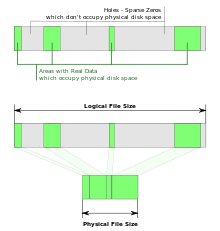
A sparse file: Empty bytes don't demand to be saved, thus they can be represented past metadata.
Sparse files are files interspersed with empty segments for which no actual storage infinite is used. To the applications, the file looks similar an ordinary file with empty regions seen as regions filled with zeros.[69] A thin file does non necessarily include sparse zeros areas; the "sparse file" attribute just means that the file is immune to have them.
Database applications, for instance, may use sparse files.[lxx] As with compressed files, the actual sizes of sparse files are not taken into account when determining quota limits.[71]
Volume Shadow Copy [edit]
The Book Shadow Copy Service (VSS) keeps historical versions of files and folders on NTFS volumes by copying former, newly overwritten data to shadow re-create via re-create-on-write technique. The user may later request an earlier version to be recovered. This also allows data fill-in programs to archive files currently in use by the file system.
Windows Vista too introduced persistent shadow copies for use with System Restore and Previous Versions features. Persistent shadow copies, however, are deleted when an older operating system mounts that NTFS volume. This happens because the older operating system does not empathise the newer format of persistent shadow copies.[72]
Transactions [edit]
Every bit of Windows Vista, applications can utilize Transactional NTFS (TxF) to group multiple changes to files together into a unmarried transaction. The transaction will guarantee that either all of the changes happen, or none of them do, and that no application outside the transaction volition come across the changes until they are committed.[73]
It uses similar techniques as those used for Volume Shadow Copies (i.e. copy-on-write) to ensure that overwritten data can be safely rolled dorsum, and a CLFS log to mark the transactions that have all the same not been committed, or those that accept been committed just nonetheless not fully applied (in example of system crash during a commit by i of the participants).
Transactional NTFS does non restrict transactions to just the local NTFS book, simply too includes other transactional data or operations in other locations such every bit data stored in separate volumes, the local registry, or SQL databases, or the electric current states of organization services or remote services. These transactions are coordinated network-wide with all participants using a specific service, the DTC, to ensure that all participants will receive aforementioned commit land, and to transport the changes that accept been validated by any participant (so that the others can invalidate their local caches for old information or rollback their ongoing uncommitted changes). Transactional NTFS allows, for instance, the cosmos of network-wide consistent distributed file systems, including with their local live or offline caches.
Microsoft at present advises against using TxF: "Microsoft strongly recommends developers use alternative means" since "TxF may not be available in future versions of Microsoft Windows".[74]
Quotas [edit]
Disk quotas were introduced in NTFS v3. They allow the ambassador of a calculator that runs a version of Windows that supports NTFS to set up a threshold of deejay space that users may use. It also allows administrators to proceed rails of how much disk infinite each user is using. An administrator may specify a certain level of disk infinite that a user may utilise before they receive a warning, so deny admission to the user one time they hit their upper limit of space. Disk quotas do non take into business relationship NTFS's transparent file-compression, should this be enabled. Applications that query the corporeality of complimentary space will likewise see the amount of free space left to the user who has a quota practical to them.
Reparse points [edit]
Introduced in NTFS v3, NTFS reparse points are used by associating a reparse tag in the user space aspect of a file or directory. Microsoft includes several default tags including symbolic links, directory junction points and book mount points. When the Object Manager parses a file arrangement name lookup and encounters a reparse aspect, it will reparse the proper noun lookup, passing the user controlled reparse data to every file arrangement filter driver that is loaded into Windows. Each filter commuter examines the reparse data to run into whether it is associated with that reparse signal, and if that filter driver determines a match, and so information technology intercepts the file arrangement request and performs its special functionality.
Limitations [edit]
Resizing [edit]
Starting with Windows Vista Microsoft added the built-in ability to shrink or aggrandize a partition. However, this ability does not relocate page file fragments or files that have been marked every bit unmovable, then shrinking a volume will oftentimes require relocating or disabling any folio file, the alphabetize of Windows Search, and whatever Shadow Copy used by System Restore. Various third-party tools are capable of resizing NTFS partitions.
OneDrive [edit]
Since 2017, Microsoft requires the OneDrive file construction to reside on an NTFS disk.[75] This is because OneDrive Files On-Demand feature uses NTFS reparse points to link files and folders that are stored in OneDrive to the local filesystem, making the file or folder unusable with any previous version of Windows, with any other NTFS file organisation commuter, or any file system and backup utilities non updated to support it.[76]
Structure [edit]
NTFS is made up of several components including: a partition boot sector (PBS) that holds boot data; the master file table that stores a record of all files and folders in the filesystem; a series of meta files that assist construction meta data more than efficiently; data streams and locking mechanisms.
Internally, NTFS uses B-copse to index file organization data. A file system journal is used to guarantee the integrity of the file system metadata merely not individual files' content. Systems using NTFS are known to take improved reliability compared to FAT file systems.[77]
NTFS allows any sequence of sixteen-bit values for name encoding (e.m. file names, stream names or index names) except 0x0000. This means UTF-16 code units are supported, merely the file arrangement does not check whether a sequence is valid UTF-sixteen (it allows whatsoever sequence of brusque values, not restricted to those in the Unicode standard). In Win32 namespace, any UTF-16 code units are instance insensitive whereas in POSIX namespace they are case sensitive. File names are limited to 255 UTF-16 code units. Sure names are reserved in the volume root directory and cannot be used for files. These are $MFT, $MFTMirr, $LogFile, $Book, $AttrDef, . (dot), $Bitmap, $Kicking, $BadClus, $Secure, $UpCase, and $Extend.[5] . (dot) and $Extend are both directories; the others are files. The NT kernel limits full paths to 32,767 UTF-sixteen code units. There are some additional restrictions on code points and file names.[78]
Segmentation Kicking Sector (PBS) [edit]
This kick partition format is roughly based upon the earlier FAT filesystem, but the fields are in dissimilar locations. Some of these fields, specially the "sectors per track", "number of heads" and "hidden sectors" fields may incorporate dummy values on drives where they either do not make sense or are not determinable.
The OS first looks at the 8 bytes at 0x30 to find the cluster number of the $MFT, and so multiplies that number by the number of sectors per cluster (i byte institute at 0x0D). This value is the sector kickoff (LBA) to the $MFT, which is described below.
Master File Tabular array [edit]
In NTFS, all file, directory and metafile data—file proper noun, creation appointment, admission permissions (by the employ of admission command lists), and size—are stored as metadata in the Chief File Table (MFT). This abstract approach immune piece of cake addition of file organisation features during Windows NT's development—an example is the addition of fields for indexing used by the Agile Directory software. This likewise enables fast file search software to locate named local files and folders included in the MFT very chop-chop, without requiring any other alphabetize.
The MFT structure supports algorithms which minimize deejay fragmentation.[81] A directory entry consists of a filename and a "file ID" (analogous to the inode number), which is the record number representing the file in the Main File Table. The file ID also contains a reuse count to detect stale references. While this strongly resembles the W_FID of Files-11, other NTFS structures radically differ.
A fractional copy of the MFT, called the MFT mirror, is stored to be used in instance of corruption.[82] If the get-go tape of the MFT is corrupted, NTFS reads the second tape to notice the MFT mirror file. Locations for both files are stored in the boot sector.[83]
Metafiles [edit]
NTFS contains several files that define and organize the file system. In all respects, most of these files are structured like any other user file ($Book being the most peculiar), but are not of directly interest to file system clients.[84] These metafiles define files, back up critical file arrangement data, buffer file system changes, manage costless space allocation, satisfy BIOS expectations, rail bad allocation units, and shop security and disk space usage information. All content is in an unnamed information stream, unless otherwise indicated.
These metafiles are treated specially by Windows, handled direct past the NTFS.SYS driver and are difficult to directly view: special purpose-congenital tools are needed.[85] Every bit of Windows 7, the NTFS commuter completely prohibits user access, resulting in a BSoD whenever an attempt to execute a metadata file is made. 1 such tool is the nfi.exe ("NTFS File Sector Data Utility") that is freely distributed every bit role of the Microsoft "OEM Support Tools". For example, to obtain information on the "$MFT"-Master File Table Segment the post-obit command is used: nfi.exe c:\$MFT [86] Another style to bypass the restriction is to utilise seven-Cipher'due south file director and get to the low-level NTFS path \\.\X:\ (where X:\ resembles any drive/division). Here, 3 new folders will appear: $EXTEND, [DELETED] (a pseudo-folder that 7-Zip uses to attach files deleted from the file organization to view), and [SYSTEM] (another pseudo-folder that contains all the NTFS metadata files). This fox can be used from removable devices (USB flash drives, external hard drives, SD Cards, etc.) inside Windows, but doing this on the active partitioning requires offline access (namely WinRE).
Attribute lists, attributes, and streams [edit]
For each file (or directory) described in the MFT tape, there is a linear repository of stream descriptors (too named attributes), packed together in one or more MFT records (containing the so-called attributes list), with extra padding to fill the fixed 1 KB size of every MFT record, and that fully describes the effective streams associated with that file.
Each attribute has an attribute type (a fixed-size integer mapping to an attribute definition in file $AttrDef), an optional attribute proper noun (for example, used every bit the name for an alternate data stream), and a value, represented in a sequence of bytes. For NTFS, the standard data of files, the alternating information streams, or the index data for directories are stored as attributes.
According to $AttrDef, some attributes can be either resident or non-resident. The $DATA aspect, which contains file data, is such an example. When the attribute is resident (which is represented by a flag), its value is stored directly in the MFT tape. Otherwise, clusters are allocated for the data, and the cluster location information is stored equally data runs in the attribute.
- For each file in the MFT, the attributes identified by aspect type, aspect name must be unique. Additionally, NTFS has some ordering constraints for these attributes.
- In that location is a predefined null aspect type, used to indicate the end of the list of attributes in one MFT record. It must be nowadays equally the last attribute in the record (all other storage infinite available after information technology volition be ignored and only consists of padding bytes to match the record size in the MFT).
- Some aspect types are required and must be nowadays in each MFT record, except unused records that are just indicated by null attribute types.
- This is the case for the $STANDARD_INFORMATION attribute that is stored as a fixed-size record and contains the timestamps and other basic single-bit attributes (compatible with those managed by Fatty in DOS or Windows 9x).
- Some attribute types cannot have a name and must remain anonymous.
- This is the example for the standard attributes, or for the preferred NTFS "filename" attribute type, or the "short filename" aspect type, when information technology is too present (for compatibility with DOS-like applications, run across beneath). It is also possible for a file to comprise only a short filename, in which case it will be the preferred 1, as listed in the Windows Explorer.
- The filename attributes stored in the attribute list exercise not make the file immediately accessible through the hierarchical file organization. In fact, all the filenames must be indexed separately in at least one other directory on the aforementioned volume. There information technology must have its own MFT record and its own security descriptors and attributes that reference the MFT record number for this file. This allows the same file or directory to be "hardlinked" several times from several containers on the same volume, possibly with distinct filenames.
- The default data stream of a regular file is a stream of type $Information merely with an bearding proper name, and the ADSs are like just must exist named.
- On the other hand, the default information stream of directories has a distinct type, but are not anonymous: they accept an aspect name ("$I30" in NTFS iii+) that reflects its indexing format.
All attributes of a given file may be displayed by using the nfi.exe ("NTFS File Sector Information Utility") that is freely distributed as part of the Microsoft "OEM Support Tools".[86]
Windows system calls may handle alternating information streams.[five] Depending on the operating arrangement, utility and remote file system, a file transfer might silently strip data streams.[v] A safe manner of copying or moving files is to utilize the BackupRead and BackupWrite system calls, which let programs to enumerate streams, to verify whether each stream should be written to the destination volume and to knowingly skip unwanted streams.[5]
Resident vs. not-resident attributes [edit]
To optimize the storage and reduce the I/O overhead for the very mutual case of attributes with very pocket-sized associated value, NTFS prefers to place the value inside the attribute itself (if the size of the attribute does not then exceed the maximum size of an MFT record), instead of using the MFT record space to list clusters containing the data; in that case, the attribute will not store the data straight only will simply store an allocation map (in the form of data runs) pointing to the actual data stored elsewhere on the volume.[87] When the value can exist accessed directly from inside the attribute, it is called "resident information" (by computer forensics workers). The amount of information that fits is highly dependent on the file's characteristics, but 700 to 800 bytes is common in single-stream files with non-lengthy filenames and no ACLs.
- Some attributes (such as the preferred filename, the basic file attributes) cannot be made non-resident. For non-resident attributes, their allotment map must fit inside MFT records.
- Encrypted-by-NTFS, sparse data streams, or compressed information streams cannot be made resident.
- The format of the allocation map for non-resident attributes depends on its adequacy of supporting sparse data storage. In the electric current implementation of NTFS, once a non-resident data stream has been marked and converted as sparse, it cannot be changed back to non-sparse data, so it cannot become resident once again, unless this data is fully truncated, discarding the sparse allocation map completely.
- When a non-resident attribute is so fragmented, that its effective allocation map cannot fit entirely within one MFT record, NTFS stores the attribute in multiple records. The first 1 among them is chosen the base record, while the others are called extension records. NTFS creates a special attribute $ATTRIBUTE_LIST to store information mapping dissimilar parts of the long attribute to the MFT records, which ways the allocation map may be separate into multiple records. The $ATTRIBUTE_LIST itself can also be non-resident, but its own allocation map must fit within one MFT record.
- When at that place are too many attributes for a file (including ADS's, extended attributes, or security descriptors), then that they cannot fit all within the MFT record, extension records may also be used to store the other attributes, using the same format as the i used in the base of operations MFT record, merely without the infinite constraints of one MFT record.
The allocation map is stored in a course of data runs with compressed encoding. Each data run represents a contiguous group of clusters that store the attribute value. For files on a multi-GB volume, each entry can exist encoded as 5 to 7 bytes, which means a i KB MFT record can shop most 100 such information runs. However, every bit the $ATTRIBUTE_LIST too has a size limit, information technology is dangerous to take more than 1 million fragments of a single file on an NTFS volume, which also implies that it is in full general not a skilful idea to use NTFS compression on a file larger than 10GB.[88]
The NTFS file arrangement driver volition sometimes endeavor to relocate the data of some of the attributes that can be made non-resident into the clusters, and will also endeavor to relocate the data stored in clusters back to the attribute inside the MFT record, based on priority and preferred ordering rules, and size constraints.
Since resident files practice not direct occupy clusters ("allocation units"), it is possible for an NTFS volume to contain more files on a volume than there are clusters. For example, a 74.vGB partition NTFS formats with 19,543,064 clusters of 4KB. Subtracting system files (a 64MB log file, a 2,442,888-byte Bitmap file, and about 25 clusters of fixed overhead) leaves 19,526,158 clusters free for files and indices. Since there are four MFT records per cluster, this volume theoretically could hold nigh 4 × xix,526,158= 78,104,632 resident files.
Opportunistic locks [edit]
Opportunistic file locks (oplocks) permit clients to modify their buffering strategy for a given file or stream in order to increase performance and reduce network employ.[89] Oplocks apply to the given open stream of a file and do not affect oplocks on a different stream.
Oplocks can be used to transparently access files in the groundwork. A network customer may avoid writing information into a file on a remote server if no other procedure is accessing the data, or information technology may buffer read-ahead data if no other process is writing data.
Windows supports four different types of oplocks:
- Level ii (or shared) oplock: multiple readers, no writers (i.e. read caching).
- Level 1 (or exclusive) oplock: exclusive access with capricious buffering (i.east. read and write caching).
- Batch oplock (also exclusive): a stream is opened on the server, but closed on the customer car (i.e. read, write and handle caching).
- Filter oplock (also exclusive): applications and file system filters tin can "back out" when others try to admission the aforementioned stream (i.due east. read and write caching) (since Windows 2000)
Opportunistic locks have been enhanced in Windows 7 and Windows Server 2008 R2 with per-client oplock keys.[xc]
Time [edit]
Windows NT and its descendants keep internal timestamps equally UTC and make the advisable conversions for display purposes; all NTFS timestamps are in UTC.[ citation needed ]
For historical reasons, the versions of Windows that exercise not back up NTFS all keep time internally as local zone fourth dimension, and therefore so practise all file systems – other than NTFS – that are supported past current versions of Windows. This means that when files are copied or moved between NTFS and non-NTFS partitions, the OS needs to convert timestamps on the fly. But if some files are moved when daylight saving time (DST) is in event, and other files are moved when standard time is in effect, in that location can be some ambiguities in the conversions. As a effect, especially soon after one of the days on which local zone fourth dimension changes, users may observe that some files have timestamps that are incorrect by one hour. Due to the differences in implementation of DST in unlike jurisdictions, this can effect in a potential timestamp mistake of up to iv hours in any given 12 months.[91]
Run into also [edit]
- Comparing of file systems
- NTFSDOS
- ntfsresize
- WinFS (a canceled Microsoft filesystem)
- ReFS, a newer Microsoft filesystem
References [edit]
- ^ a b c Karresand, Martin; Axelsson, Stefan; Dyrkolbotn, Geir Olav (2019-07-01). "Using NTFS Cluster Allocation Beliefs to Find the Location of User Data". Digital Investigation. 29: –51–S60. doi:10.1016/j.diin.2019.04.018. ISSN 1742-2876. S2CID 199004263. Retrieved 2021-12-01 .
- ^ a b "Glossary". [MS-EFSR]: Encrypting File Arrangement Remote (EFSRPC) Protocol. Microsoft. fourteen November 2013.
- ^ "How NTFS Works". TechNet. Microsoft. Retrieved 2 Dec 2017.
- ^ "B*Trees - NTFS Directory Copse - Conecpt - NTFS Documentation". flatcap.org . Retrieved 2019-05-13 .
- ^ a b c d e f g "How NTFS Works". Windows Server 2003 Technical Reference. 2003-03-28. Retrieved 2011-09-12 .
- ^ a b c d "Appendix A: Product Behavior". [MS-FSA]: File System Algorithms. Microsoft. 2018-09-12. Retrieved 2018-ten-01 .
NTFS uses a default cluster size of four KB, a maximum cluster size of 64 KB on Windows 10 v1703 operating system and Windows Server 2016 and prior, and 2 MB on Windows ten v1709 operating system and Windows Server 2019 and later, and a minimum cluster size of 512 bytes.
- ^ "Appendix A: Product Beliefs". [MS-FSA]: File System Algorithms. Microsoft. 14 November 2013. Retrieved 2012-09-21 .
- ^ a b Russon, Richard; Fledel, Yuval. "NTFS Documentation" (PDF) . Retrieved 2011-06-26 .
- ^ https://bugs.winehq.org/show_bug.cgi?id=51808#c2
- ^ Rick Vanover. "Windows Server viii data deduplication". Retrieved 2011-12-02 .
- ^ a b Custer, Helen (1994). Within the Windows NT File Arrangement. Microsoft Press. ISBN978-i-55615-660-1.
- ^ "NTFS3 — The Linux Kernel documentation". www.kernel.org . Retrieved 2021-12-02 .
- ^ "ntfs-3g". www.freebsd.org . Retrieved 2021-12-02 .
- ^ "How to Convert a Drive from FAT32 to NTFS without Information Loss". WindowsLoop. 11 July 2021. Retrieved 8 August 2021.
- ^ a b cfsbloggers (July 14, 2006). "How restore points and other recovery features in Windows Vista are affected when dual-booting with Windows XP". The Filing Cabinet . Retrieved 2007-03-21 .
- ^ Kozierok, Charles. "Overview and History of NTFS". The PC Guide. Retrieved May 30, 2019.
- ^ Custer, Helen (1994). Inside the Windows NT File Arrangement. Microsoft Press. p. vii. ISBN978-1-55615-660-1.
- ^ "Recovering Windows NT Afterwards a Boot Failure on an NTFS Drive". Microsoft. Nov 1, 2006.
- ^ a b Russinovich, Mark. "Inside Win2K NTFS, Part 1". MSDN. Microsoft. Retrieved 2008-04-18 .
- ^ "What's New in Windows NT 4.0 Service Pack 4?". Microsoft.com. 12 January 1999. Archived from the original on 17 January 1999. Retrieved 17 Baronial 2018.
- ^ "New Capabilities and Features of the NTFS three.one File System". Microsoft. one December 2007.
- ^ Loveall, John (2006). "Storage improvements in Windows Vista and Windows Server 2008" (PowerPoint). Microsoft. pp. 14–20. Retrieved 2007-09-04 .
- ^ "Booting from GPT". Rodsbooks.com . Retrieved 22 September 2018.
- ^ "NTFS vs Fat vs exFAT - NTFS.com". www.ntfs.com . Retrieved 2021-01-19 .
- ^ "How to Convert Fat Disks to NTFS". Microsoft. Retrieved May 30, 2019.
- ^ "How to utilise Convert.exe to convert a division to the NTFS file arrangement". Microsoft Corporation. 2007-02-12. Retrieved 2010-12-26 .
- ^ "FreeBSD iii.ii Release Notes". 17 May 1999. Retrieved 2020-06-15 .
- ^ a b "mount_ntfs - OpenBSD transmission pages". Retrieved 2020-06-15 .
- ^ "Announcing NetBSD one.5". 6 December 2000. Retrieved 2020-06-15 .
- ^ "OpenBSD 4.ix". Openbsd.com . Retrieved 22 September 2018.
- ^ a b "NTFS Credits and History". Linux-NTFS Project . Retrieved 2021-09-05 .
- ^ "Kernel development". lwn.net. two May 2002. Retrieved 2021-09-05 .
- ^ "Release notes for v2.5.11". 29 April 2002. Retrieved 2021-09-05 .
- ^ "two.half-dozen.15 changelog". Linux projection. 3 January 2006. Retrieved 2021-09-05 .
- ^ Anderson, Tim (2021-09-06). "GitHub merges 'useless garbage' says Linus Torvalds equally new NTFS back up added to Linux kernel 5.15". The Register . Retrieved 2021-09-07 .
- ^ "OpenBSD adds fuse(4) support for calculation file systems in userland". OpenBSD Journal. 2013-xi-08. Retrieved 2013-11-08 .
- ^ "NTFS-3G Stable Read/Write Driver". 2009-07-25.
- ^ "Tuxera NTFS for Mac". Tuxera. Baronial thirty, 2011. Retrieved September twenty, 2011.
- ^ "Jan Kratochvil: Captive: The first free NTFS read/write filesystem for GNU/Linux". Retrieved 2020-06-15 .
- ^ "Near Tuxera". Retrieved 2020-06-15 .
- ^ "10.6: Enable native NTFS read/write support". 1 October 2009. Retrieved 5 September 2021.
- ^ "NTFS for Mac OS Ten, communication channel betwixt Mac Bone X and Windows". Paragon Software Grouping. Retrieved September 20, 2011.
- ^ "The Leader in Mass Data Storage Solutions | Seagate United states of america". Seagate.com. Archived from the original on Feb x, 2011.
- ^ "NTFS plugin for NetDrive". ecsoft2.org . Retrieved 2020-09-09 .
- ^ "NetDrive for OS/2". arcanoae.com . Retrieved 2020-09-09 .
- ^ "Avira NTFS4DOS Personal". Archived from the original on June 19, 2010. Retrieved 2009-07-25 .
- ^ "Download Avira NTFS4DOS Personal 1.9". Archived from the original on 10 November 2013. Retrieved 22 September 2018.
- ^ a b "How Security Descriptors and Access Command Lists Work". TechNet. Microsoft. Retrieved 4 September 2015.
- ^ Morello, John (February 2007). "Security Picket Deploying EFS: Part 1". Technet Magazine. Microsoft. Retrieved 2009-01-25 .
- ^ "How EFS Works". Windows 2000 Resource Kit. Microsoft. Retrieved 25 February 2014.
- ^ "Windows viii book compatibility considerations with prior versions of Windows". Retrieved 2021-12-17 .
- ^ "Change Journals (Windows)". MSDN. Retrieved 2010-04-16 .
- ^ "Creating, Modifying, and Deleting a Modify Periodical (Windows)". MSDN. Retrieved 2010-04-16 .
- ^ "Affiliate 29 – POSIX Compatibility". MS Windows NT Workstation 4.0 Resources Guide. Microsoft. 1995. Retrieved 21 October 2013.
- ^ "Hard Links and Junctions". MSDN. Microsoft. 12 October 2013. Retrieved 21 Oct 2013.
- ^ "MSDN – CreateHardLink part". Retrieved 14 Jan 2016.
- ^ Russinovich, Mark Due east.; Solomon, David A.; Ionescu, Alex (2009). "File Systems". Windows Internals (5th ed.). Microsoft Press. p. 921. ISBN978-0-7356-2530-iii.
1 component in Windows that uses multiple information streams is the Attachment Execution Service[...] depending on which zone the file was downloaded from [...] Windows Explorer might warn the user
- ^ "Streams - Windows Sysinternals". Technet.microsoft.com . Retrieved 22 September 2018.
- ^ "FileSystem Provider". Microsoft. 9 August 2012. Archived from the original on 23 January 2015. Retrieved 23 January 2015.
- ^ Malware utilising Alternate Data Streams? Archived 2008-07-23 at the Wayback Machine, AusCERT Web Log, 21 August 2007
- ^ "File Compression and Decompression". MSDN Platform SDK: File Systems. Retrieved 2005-08-18 .
- ^ "Compact OS, single-instancing, and image optimization". Microsoft. Retrieved 1 October 2019.
- ^ "The Default Cluster Size for the NTFS and FAT File Systems". Microsoft. January 31, 2002. Retrieved 2012-01-ten .
- ^ Masiero, Manuel (2011-12-01). "Should You Shrink Data On Your SSD?". Tom'southward Hardware. Bestofmedia Grouping. Retrieved 2013-04-05 .
- ^ "How NTFS Works". 2003-03-28. Retrieved 2011-ten-24 .
- ^ a b Middleton, Dennis. "Understanding NTFS Pinch". Ntdebugging Web log. Microsoft. Retrieved 2011-03-16 .
- ^ "Shrinking the gap: carving NTFS-compressed files". Retrieved 2011-05-29 .
- ^ "Deejay Concepts and Troubleshooting". Microsoft. Retrieved 2012-03-26 .
- ^ "Sparse Files". MSDN. Microsoft. 12 Oct 2013. Retrieved 21 Oct 2013.
- ^ Kandoth, Suresh B. (4 March 2009). "Sparse File Errors: 1450 or 665 due to file fragmentation: Fixes and Workarounds". CSS SQL Server Engineers. Microsoft. Retrieved 21 October 2013.
- ^ "Sparse Files and Deejay Quotas". MSDN Library. Microsoft. 12 October 2013. Retrieved 21 Oct 2013.
- ^ cfsbloggers (July 14, 2006). "How restore points and other recovery features in Windows Vista are affected when you lot dual-boot with Windows XP". The Filing Cabinet . Retrieved 2007-03-21 .
- ^ "Transactional NTFS". MSDN. Microsoft. Retrieved 2007-02-02 .
- ^ "Transactional NTFS (TxF)". Windows Dev Heart (MSDN). Microsoft. Retrieved 24 May 2015.
- ^ "Unable to open content synced in a OneDrive folder on an external bulldoze". Microsoft Support . Retrieved 2021-04-03 .
- ^ André, Jean-Pierre (March 1, 2019). "NTFS-3G: Junction Points, Symbolic Links and Reparse Points". jp-andre.pagesperso-orange.fr.
- ^ "Chapter 18 – Choosing a File System". MS Windows NT Workstation 4.0 Resource Guide. Microsoft. Retrieved 25 February 2014.
- ^ "Naming Files, Paths, and Namespaces". MSDN. Microsoft. Naming Conventions. Retrieved 25 February 2014.
- ^ "NTFS. Partition Boot Sector". Ntfs.com . Retrieved 22 September 2018.
- ^ "Kicking Sector". Technet.microsoft.com . Retrieved 22 September 2018.
- ^ "Master File Tabular array". MSDN. July ii, 2012.
- ^ "Forensics: What is the MFT Mirror?". Where is Your Data?. 2009-06-05. Retrieved 2021-07-30 .
- ^ "NTFS Principal File Tabular array (MFT)". Ntfs.com . Retrieved 22 September 2018.
- ^ Schwarz, Thomas. "COEN 252 Estimator Forensics NTFS". Faculty of Organization and Computer science University of Zagreb. Archived from the original on 2021-02-27. Retrieved May 30, 2019.
- ^ Since Windows XP, it is very difficult to view a listing of these files: they exist in the root directory'southward index, simply the Win32 interface filters them out. In NT 4.0, the command line
dircontrol would listing the metafiles in the root directory if/awere specified. In Windows 2000,dir /astopped working, merelydir /a \$MFTworked. - ^ a b "OEM Support Tools Stage 3 Service Release 2 Availability". Microsoft Corporation. 2007-02-21. Archived from the original on 2015-02-23. Retrieved 2010-06-sixteen .
Windows NT File System (NTFS) File Sector Information Utility ... A tool used to dump information about an NTFS book
- ^ "The Four Stages of NTFS File Growth". Retrieved 22 September 2018.
- ^ "A heavily fragmented file in an NTFS volume may non grow beyond a certain size". Archived from the original on 2021-05-06. Retrieved 2021-05-19 .
- ^ "How Oplocks part in the Windows Environment: Overview". Archived from the original on 2010-08-23. Retrieved 2018-12-19 .
- ^ "What'due south New in NTFS". Technet.microsoft.com . Retrieved 22 September 2018.
- ^ "Beating the Daylight Saving Time bug and getting correct file modification times Archived 2004-xi-xiv at the Wayback Motorcar" The Code Projection
Further reading [edit]
- Bolosky, William J.; Corbin, Scott; Goebel, David; Douceur, John R. (January 2000). "Single Case Storage in Windows 2000". Proceedings of 4th USENIX Windows Systems Symposium.
- Custer, Helen (1994). Inside the Windows NT File System. Microsoft Printing. ISBN978-1-55615-660-1.
- Nagar, Rajeev (1997). Windows NT File Arrangement Internals: A Developer's Guide. O'Reilly. ISBN978-1-56592-249-five.
- "NTFS Technical Reference". Microsoft TechNet. Microsoft. 28 March 2003.

Which Of The Following Is The Maximum Disk Size Supported When Using Gpt Partitioning?,
Source: https://en.wikipedia.org/wiki/NTFS
Posted by: mendeztiostiont.blogspot.com
0 Response to "Which Of The Following Is The Maximum Disk Size Supported When Using Gpt Partitioning?"
Post a Comment